I teach undergraduate and graduate courses in urban history, environmental history, social movement history, social and cultural methods, and histories of capitalism in the 20th century U.S.
A sample of my teaching portfolio is below (syllabi available upon request).
-
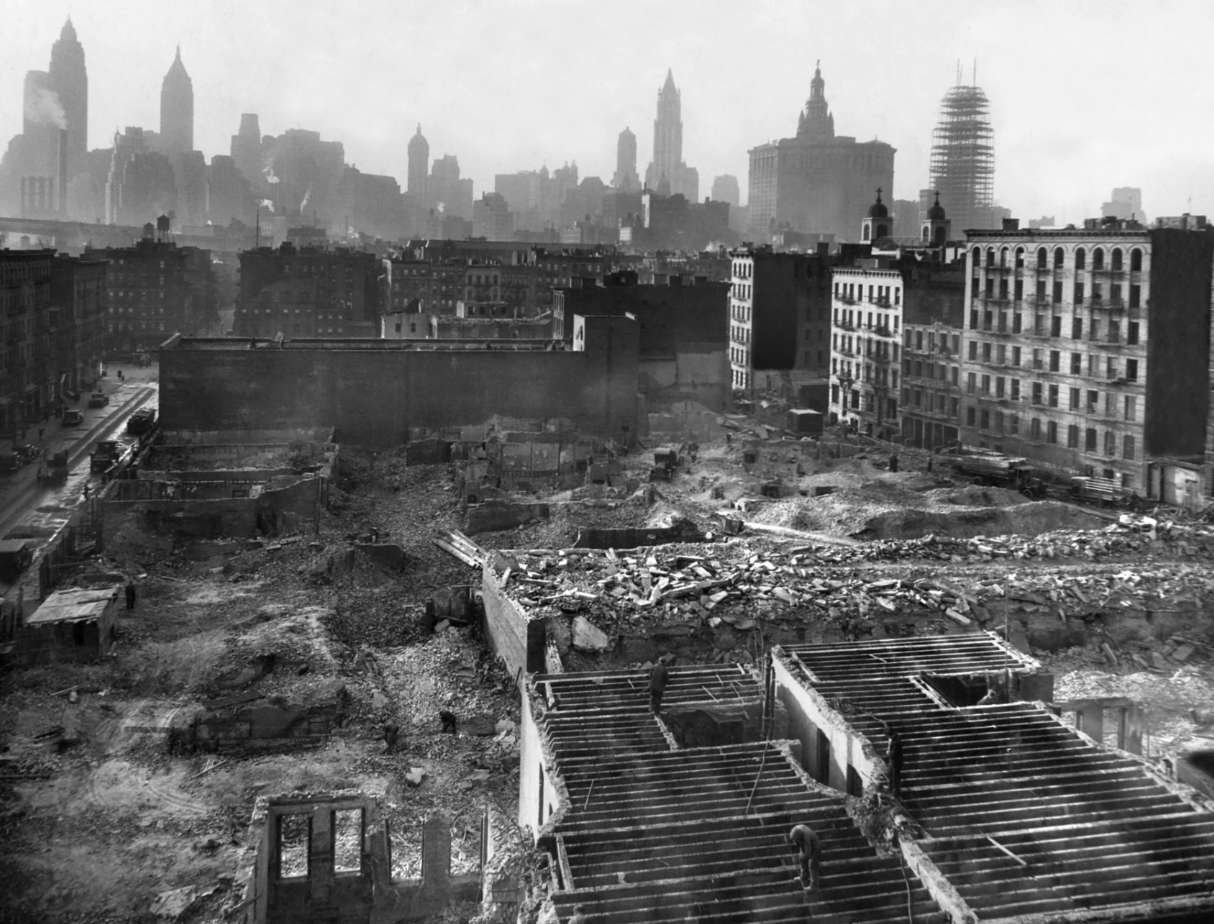
The American City: 1890-Present
Summer 2025, Queens College CUNY
“We will neglect our cities to our peril, for in neglecting them we neglect the nation.” -- John F. Kennedy
“Walk through the streets of Harlem and see what we, this nation, have become.” -- James Baldwin
This course provides a comprehensive overview of the development of the American city in the 20th century and its impact on society, culture, ethnicity, race and gender, economics, and politics. We will examine the changing geography of cities across the country, the social and cultural patterns of urban life, and the impact of class, race, and ethnicity on the urban experience. Students will develop the analytical tools necessary to approach urban history as critical readers, writers, and thinkers. A primary goal is to develop your research and writing skills by exploring overarching questions, examining primary sources, and interpreting a range of material.
Together, we will ask the following questions: What makes urban life distinctive? What roles have cities played in shaping American culture? How can we interpret urban life through social, political, economic, and cultural institutions? How should we think about public and private spaces as defined in changing urban environments? How have cities changed over time, and what is the future of the American city?
-
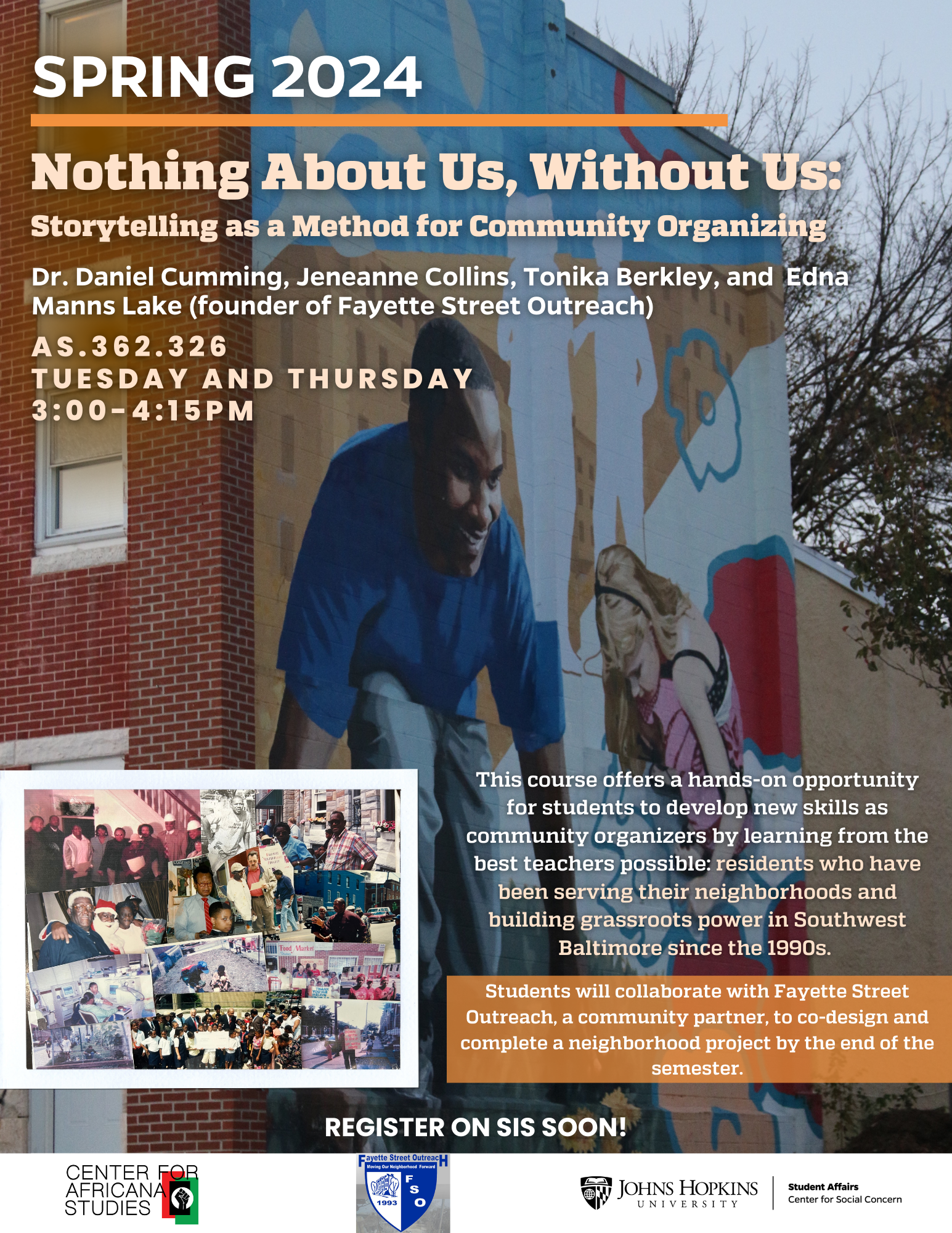
Nothing About Us, Without Us: Storytelling as a Method for Community Organizing
Spring 2024, Johns Hopkins University
This course offers a hands-on opportunity for students to develop new skills as community organizers by learning from the best teachers possible: residents who have been serving their neighborhoods and building grassroots power in Southwest Baltimore since the 1990s. As a community-based learning course partnered with the Center for Social Concern, and co-taught by professors, archivists, cultural curators, and longtime residents, including the founder of Fayette Street Outreach, Ms. Edna Manns-Lake, this course will leverage the narrative power of storytelling to help rewrite a multigenerational history of community organizing in a part of the city long neglected by local government and threatened by open-air drug markets, criminalization, and housing speculators.
Through community immersion, including oral histories, community archiving, local meetings, and guest presentations, students will learn how to navigate, identify, and build upon neighborhood assets. Students will then collaborate with a community partner to co-design and complete a neighborhood project by the end of the semester.
-
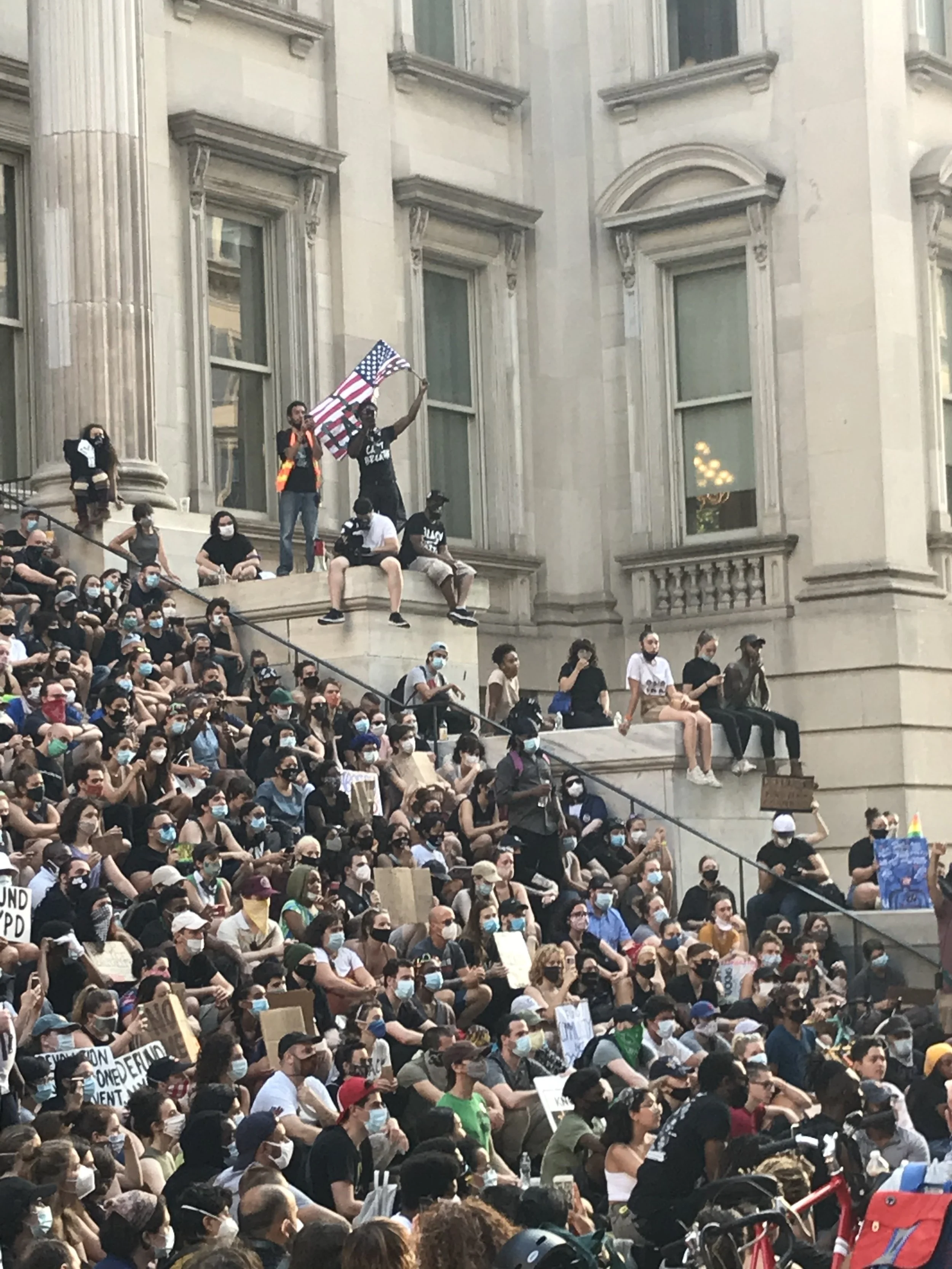
Abolition and the University
Fall 2023 and Fall 2024, Johns Hopkins University
This course explores the history of the modern university system through the lens of abolitionist politics, from W.E.B. DuBois’s “abolition democracy” to today’s leading scholar-activists. Students will explore the origins and expansion of the university system and trace how social movements, abolitionists in various forms, shaped the terrain of higher education over the 20th century. With roots in slavery and settler colonialism, to partnerships with the carceral state and debt regimes of the postindustrial era, academic institutions have always been locked in an existential struggle with students, workers, and residents over the function of universities and their role in future society.
At the center of this course is Johns Hopkins University and its contentious relationship with Baltimore. Through reading, films, podcasts, and writing assignments, we’ll wrestle with these local tensions while exploring national and historical forces underlying today’s rightwing assault on higher education and the Left’s long-standing “freedom dreams.” We’ll answer the following: is the university truly a democratic institution; and if not, what does abolition mean for today’s higher education system?
-
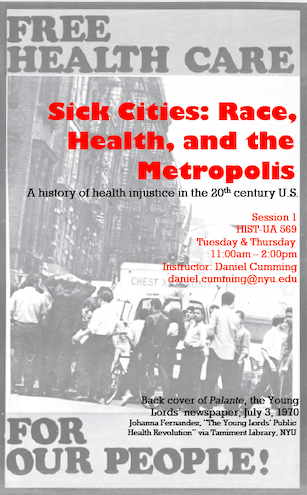
Sick Cities: Race, Health, and the Metropolis
Summer 2021, New York University (canceled to accept postdoc at JHU)
This course examines the interrelations of race and public health in the twentieth-century U.S. metropolis. Critically engaging public health experts’ research on contemporary racial health disparities, including the dramatic effects of COVID-19 on African Americans, Native Americans, and incarcerated people, among others, this course examines the history underlying the so-called “racial health gap,” or as abolitionist scholar Ruth Wilson Gilmore describes it, “the state-sanctioned or extra-legal production and exploitation of group differentiated vulnerability to premature death.”
By studying how racial ideologies formed over time and through cities’ shifting environments, this course explores the formation of key policies, institutions, systems, and movements for medical care and health justice during the twentieth century. At the heart of the course lies a contemporary paradox: why does one of the most expensive health systems in the world continue to deliver some of the worst relative outcomes, and why do racialized health inequities persist unevenly across our neighborhoods, municipalities, regions, and borders?
-
Oral History: Methods and Applications
Spring 2026, Queens College, CUNY (co-taught with Dr. Bobby Wintermute)
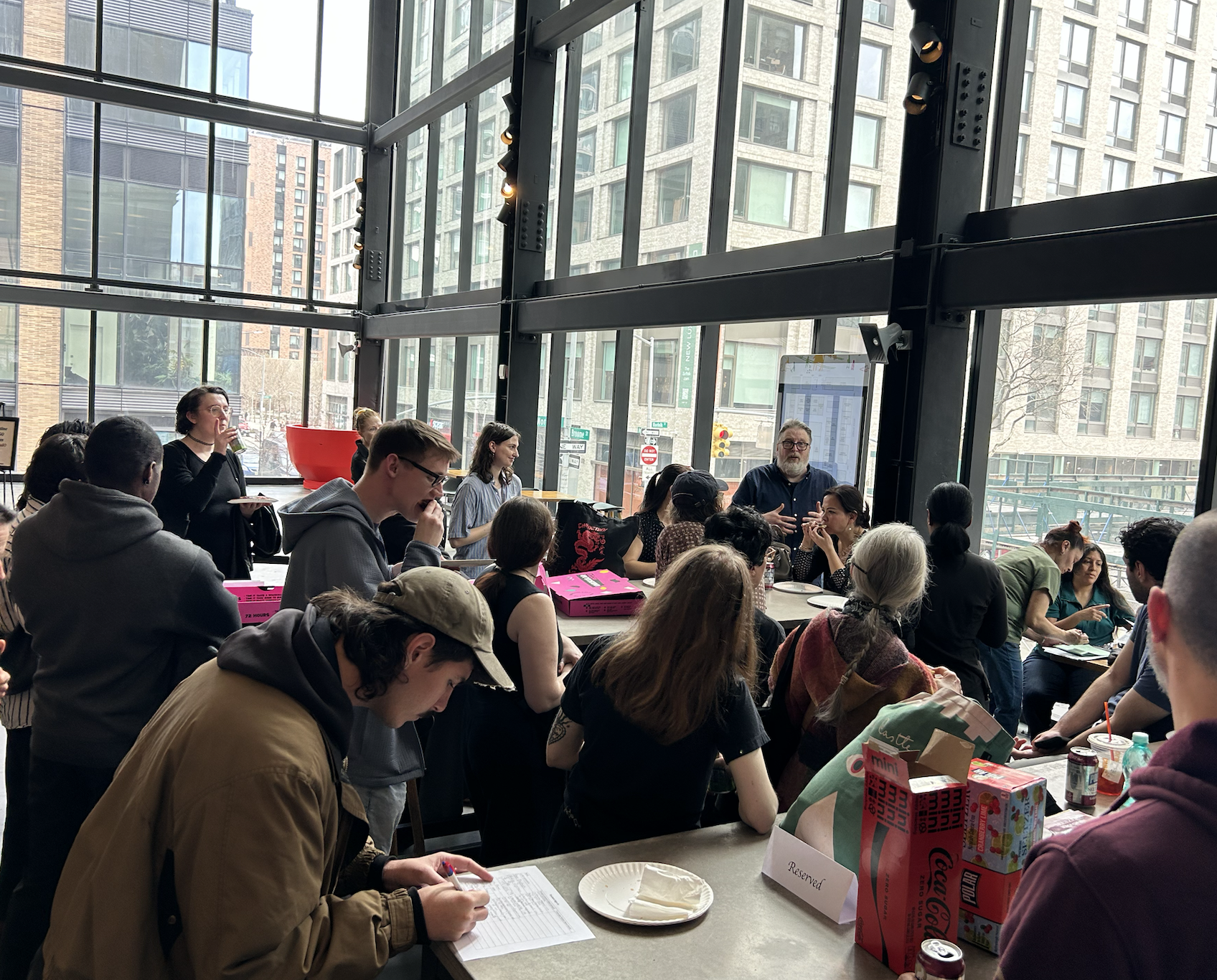
At what point do family stories become history? What are the boundaries between an official, formal “history” and the personal, individual “past”? How reliable are the casual anecdotes and stories we all have seen in popular television documentary, and how can we use them to create a clearer picture of historical events? Is “History” the exclusive product of trained professionals, or do we all share in its creation? These are just a few questions that people ask about the personal insights that others have about the past, and how they contribute to the historical record. More than any other source, oral history interviews are a deeply personal and emotionally inspirational record of the past. At their best, oral histories open a window on the past through the eyes and ears of the participant. But even bad oral history serves a purpose, as it offers even just a fleeting glimpse into the past. Our hope in this seminar is to help you understand the difference and learn how to make good oral history gathering a part of your professional toolbox as aspiring historians.
-
Give Me Shelter: Housing America in the 20th Century
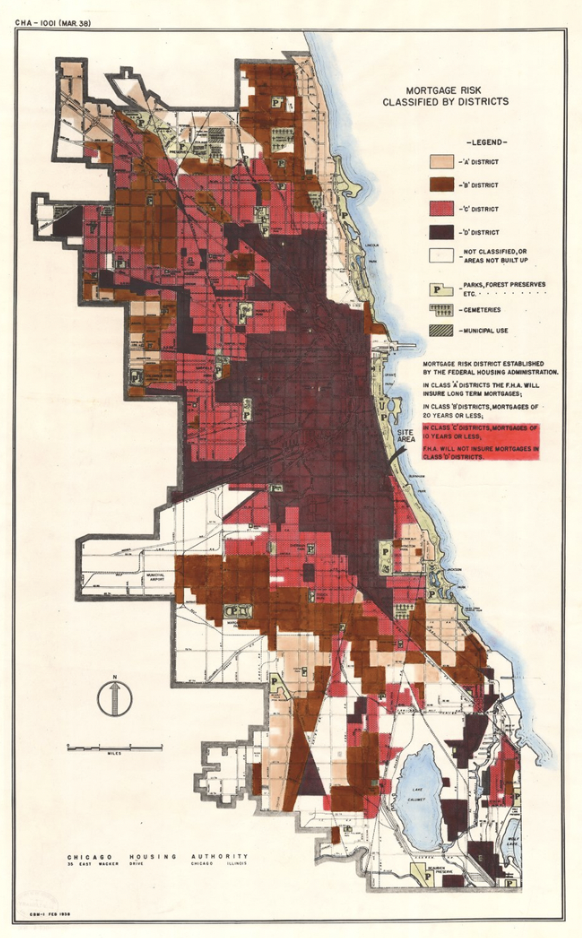
Housing is a fundamental driver of social inequality in the U.S. This course traces the public-private housing system’s origins, examines its historical influences, and explores social movements for housing justice over the long twentieth century. Through lecture and classroom discussion, students will analyze primary sources and contextualize their findings within key moments and eras of modern U.S. history.
Topics discussed will include local and federal housing policy; social citizenship and its intersections with race, class, and gender; metropolitan development, including urban and suburban politics; civil rights, tenant rights, and housing justice movements; inequality in the built environment; and financialization leading to the 2008 housing crash and beyond.